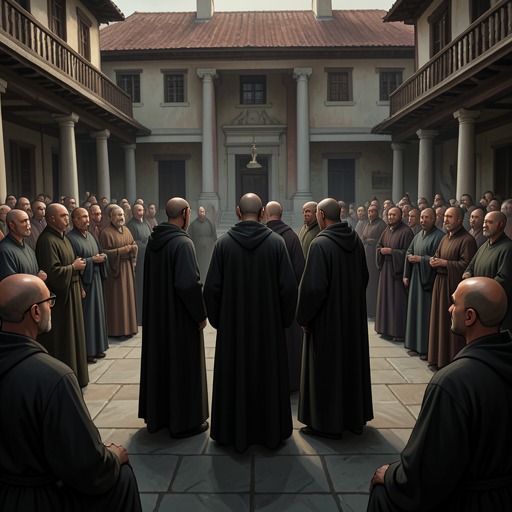
Execution of the London Charterhouse monks
Wolf HallThe execution of the London Charterhouse monks follows their repeated refusal to swear an oath demanded by the king. In the novel, their deaths turn a legal test of loyalty into a public demonstration of royal power, while revealing the limits of Thomas Cromwell’s attempts to secure compliance through persuasion and pressure.
Refusal and the Royal Oath
The London Charterhouse is described as an austere religious house whose monks sleep on straw. The community’s resistance is linked to the oath of succession: the oath has been offered to the monks repeatedly, and they have refused it. For Cromwell, this refusal is not an isolated disagreement. He has also visited the resistant community at Syon and tried several ways to change the monks’ position.
The oath belongs to a wider political effort to make allegiance enforceable throughout the realm. Cromwell intends commissioners to administer it in towns and villages, including to women with inheritances and landowners, so that people with little knowledge of Anne Boleyn will still be required to uphold the succession of her unborn child. The monks’ refusal therefore places religious resistance directly against a policy designed to secure the king’s dynastic settlement.
Attempts to Secure Compliance
Cromwell has addressed the religious communities in several registers. He has spoken gently and bluntly, threatened and cajoled, sent clerics to argue the king’s case, and interviewed dissenting members in an effort to set them against their brethren. None of these methods succeeds with the Charterhouse monks. Their answer is to ask that they be left to their chosen path toward death.
The contrast between the repeated offer of the oath and the repeated refusal gives the confrontation its shape. The monks do not change their position when faced with Cromwell’s persuasion or threats; the state, in turn, moves from argument to punishment. Their fate makes visible the coercive end of a system in which legal words are meant not merely to express allegiance but to produce it.
Trial and Execution
As April ends, four monks are put on trial. Their refusal is treated under the law as treason, exposing them to the full penalty imposed on traitors. The account emphasizes the public character of the punishment: courtiers and officials are expected to attend alongside city residents and the wider crowd. The spectacle is meant to make the consequences of resistance unmistakable.
The king considers attending in disguise, but fears that his presence might provoke demonstrations in favour of Katherine of Aragon, who remains popular with parts of the crowd. Instead, he sends Henry Fitzroy to represent him. The decision makes the execution a lesson for the young prince as well: Henry says that Fitzroy may one day have to defend his half-sister’s title in battle and should learn what slaughter looks and sounds like.
Cromwell does not attend the execution. The night before, he signs a pass allowing Margaret Roper to visit her father, Thomas More, who is imprisoned. He hopes that seeing the condemned monks might persuade More to take the oath, but the attempt fails. Roper and her father watch as the prisoners are led away; their refusal to yield strengthens, rather than weakens, More’s resolve.
After the executions, the Duke of Norfolk tells Cromwell that one monk seemed to speak after death, calling on Jesus to save them. Cromwell denies that this could have happened and attributes the voice to someone in the crowd. Norfolk accepts the explanation, though he crosses himself. The exchange leaves the reported cry unresolved within the scene, setting the official denial against the duke’s shaken testimony.
Consequences and Significance
The execution marks a change in the government’s response to religious refusal. A year earlier, the king had shown mercy to the Maid of Kent’s followers; now, the account says, he is no longer disposed to do so. The monks’ deaths demonstrate that refusing the oath can lead from examination and persuasion to the public punishment reserved for traitors.
The episode also places the oath beside other politically consequential speech in the novel. An oath can be used to establish a public obligation, while refusal becomes evidence of disloyalty; its force depends on the authority demanding it and the penalties available to enforce it. The Charterhouse monks’ deaths thus expose the central conflict between conscience and political obedience without resolving it: the state can punish refusal, but punishment does not make the monks’ assent real.